Evolution of the Dice: From Bone to Blockchain
Mark Coulter
"Architect of the Tavern and Guardian of the Distributed Beacon. Mark spends his days at the intersection of cryptography and tabletop gaming, ensuring that every natural twenty is as pure as the math that forged it."
Mark is the middle name of Karl Coulter, who writes and runs Nat20 Labs, and builds websites at Leodis Digital in Leeds.
Evolution of the Dice: From Bone to Blockchain
Take a look at that d20 in your hand. Feel the edges. The weight. The balance. To you, it’s a tool for hitting an orc. To history, it is the culmination of five thousand years of human obsession with the unknown.
We’ve always been gamblers. We’ve always been storytellers. And for as long as we’ve been both, we’ve been looking for a way to ask the universe: “What happens next?”
Today, we’re tracing the lineage of the dice. From the scorched earth of the ancient world to the cold, sterile logic of the blockchain, this is the story of how we manufactured chaos.
The Knucklebone: Randomness in the Cradle
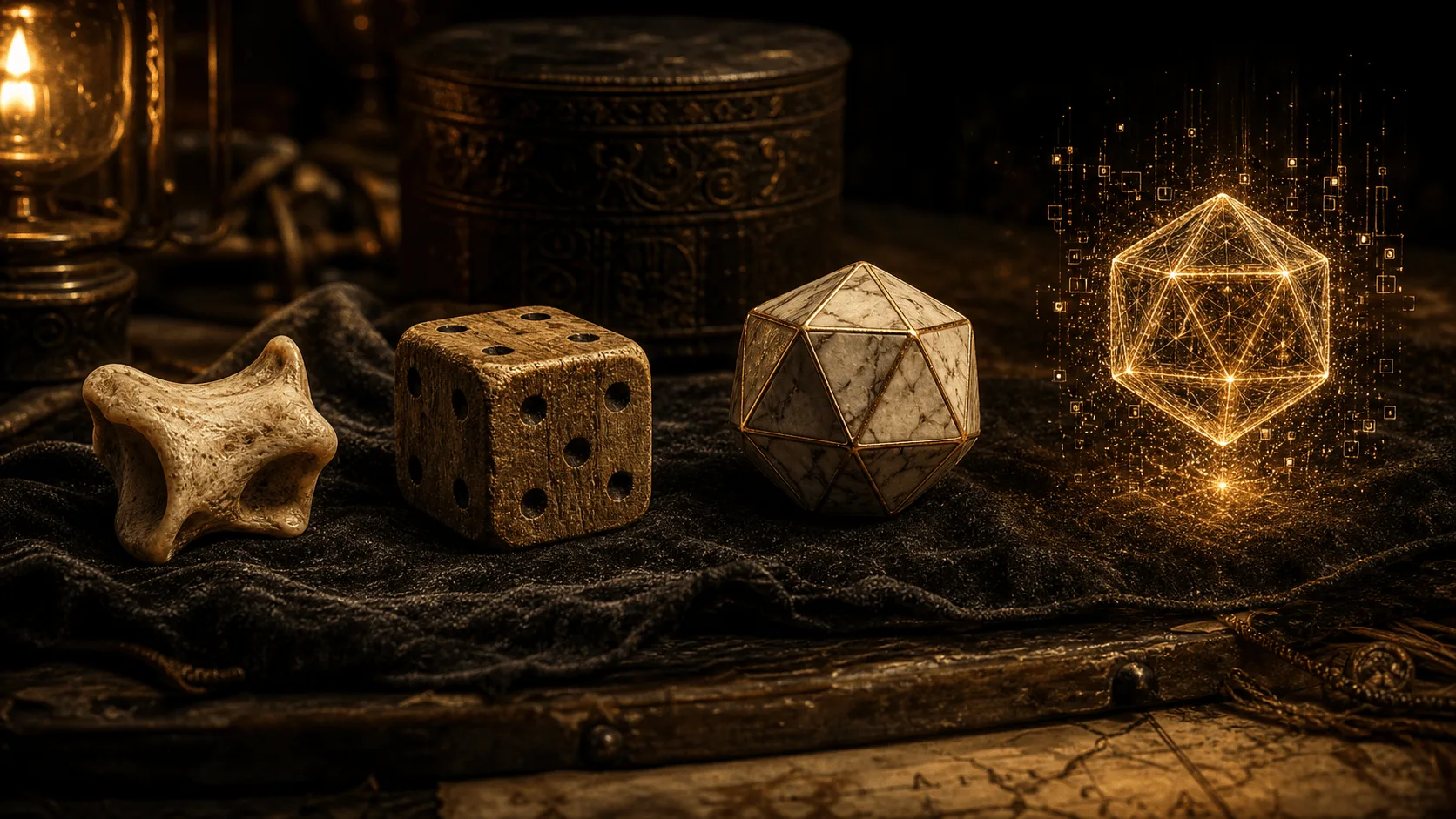
Before there was plastic, there was bone. The earliest “dice” weren’t cubes; they were the talus (ankle bones) of hoofed animals like sheep or goats. These bones, known as astragali, have four distinct sides. They were the original d4s.
In ancient Mesopotamia and Egypt, these knucklebones were used for both games and divination. To the ancients, there was no such thing as “random.” If a bone landed on a certain side, it wasn’t luck; it was the will of the gods. The line between a gambler and a priest was very thin indeed.
By 3000 BCE, we see the first evidence of six-sided dice in the Royal Tombs of Ur. These weren’t quite the cubes we know today—they were often slightly elongated or made of soft stones—but the intent was the same: a fair, multi-sided result.
The Roman Empire: The Birth of the Professional Cheat
The Romans were obsessed with dice. They played tali (knucklebones) and tesserae (cubes). Even the emperors were in on it; Augustus and Claudius were known to be heavy gamblers.
But with obsession comes innovation, and with innovation comes cheating. We have found Roman dice that were “loaded” with lead to favor certain numbers. We’ve found dice that were slightly shaved on one side.
This led to the development of the pyrgus—a dice tower. Yes, the “Dice Tower” isn’t a modern invention for lazy DMs. It was a security measure. The internal baffles of a Roman pyrgus ensured that the die was tumbled thoroughly, making it harder for a cheat to “slide” the die across the table. When you use a dice tower today, you are participating in a tradition of anti-fraud that is two thousand years old.
The Platonic Solids: Geometry Meets Gaming
For centuries, the six-sided die reigned supreme. But in the background of history, the philosophers were busy. Plato identified five regular polyhedra—shapes where every face is an identical regular polygon. These “Platonic Solids” (the tetrahedron, cube, octahedron, dodecahedron, and icosahedron) would eventually become the d4, d6, d8, d12, and d20.
However, these shapes didn’t become common gaming tools until the 20th century. Before then, the d20 was primarily used by the military for statistical sampling or by the Japanese as a tool for “magic” and divination.
The turning point came in the 1970s. When Dave Arneson and Gary Gygax were developing Dungeons & Dragons, they needed a way to model a wide range of probabilities. A d6 was too flat. A d100 was too cumbersome. The d20 was the perfect middle ground—a 5% increment for every face.
Gygax famously sourced his first sets of polyhedral dice from educational supply companies. They weren’t even sold as “dice”; they were “geometric solids” for math class. Legend has it that those early dice were so soft you had to color the numbers in with a crayon, and after a few months of rolling, they became so rounded they were basically marbles.
The Quest for the Perfect Roll: GameScience and Precision
As the hobby grew, so did the demand for fairness. In the 80s and 90s, the “Lou Zocchi” era began. Zocchi, the founder of GameScience, became a legend by preaching the gospel of precision.
He argued that most mass-produced dice were “unbalanced” because they were tumbled in stones for days to smooth their edges. This tumbling, he claimed, rounded the corners unevenly, making some numbers more likely to appear than others.
Zocchi’s dice were “sharp-edged.” They were ugly, they came with “nubs” from the injection molding that you had to sand off yourself, but they were fair. This sparked a decades-long debate in the tavern: Do you want a die that looks beautiful, or a die that represents the true face of entropy?
Today, we have high-end companies like Chessex and Kraken making beautiful resin dice, while precision-machined aluminum and tungsten dice cater to the “Math Warriors” who demand laboratory-grade randomness.
The Digital Leap: The Loss of the Tactile Soul
Then came the internet. Virtual Tabletops (VTTs) like Roll20 and Foundry changed the game. Suddenly, we weren’t rolling physical objects; we were calling a function in a piece of code.
Most digital dice use a Pseudo-Random Number Generator (PRNG). These are algorithms that take a “seed” (like the current time in milliseconds) and run it through a complex math formula to spit out a number.
To a human, it looks random. To a computer, it is perfectly predictable. If you know the seed and the algorithm, you know every roll that will ever happen.
This led to the “VTT Curse.” We’ve all been there: “The RNG is broken! It’s rolled three 1s in a row!” Mathematically, it’s fine. Psychologically, we miss the tactile feel of the die. We miss the “weight” of the roll. We feel like the computer has an agenda.
The Future: Blockchain and the League of Entropy
So, where do we go from here? How do we bring back the “Truth” of the knucklebone to the digital world?
The answer lies in Decentralized Randomness.
At Nat20Labs, we’re looking at technologies like drand. Instead of one computer deciding your fate, a “League of Entropy”—dozens of independent servers across the globe—all contribute to a single, verifiable random value.
It’s like having twenty different DMs from twenty different countries all roll a die at the same time, and then taking the combined result. No one can cheat. No one can predict the outcome. And most importantly, anyone can verify it after the fact.
This is the “Blockchain” era of dice. It’s not about crypto-currency or NFTs; it’s about using the distributed nature of the web to create a digital “astragalus” that is as fair as the laws of physics.
Conclusion: The Circle Closes
We’ve come a long way from carving sheep bones in the dirt. We’ve gone from lead-weighted Roman cubes to sharp-edged precision resin, and now to cryptographic beacons of entropy.
But the reason we roll hasn’t changed. We roll because we want to be surprised. We roll because we want to know if the hero survives, if the dragon falls, or if the tavern bill gets paid.
The die—whether it’s made of bone, plastic, or code—is our bridge to the infinite. It is the one thing in our lives that we cannot control, and in a world of schedules and scripts, that is a beautiful thing.
So, the next time you roll that d20, take a moment to appreciate the history in your palm. Five thousand years of human ingenuity, all working together to tell you that, yes, you just rolled a Natural 1.
Better luck in the next millennium, traveler.
Stay legendary.